What a composite deck costs in Morocco: the real budget, line by line
What does a composite wood deck cost in Morocco? The budget line by line, the ranges per m², a worked example for 30 m² and the mistakes to avoid.
Ask what a composite deck costs in Morocco and you almost always get the same answer: “it depends”. True, but not useful. This article does the opposite: it gives you the structure of the budget, the proportions between the lines, and a method you can apply to your own project before you even ask for a quote.
A word of warning first. The ranges quoted here are orders of magnitude observed on the Moroccan market, meant to frame your thinking. They vary with the density of the material, the brand, the quantity ordered and the delivery region. Only a take-off on your real dimensions gives an exact figure — it is free, and we come back to it at the end.
The four lines of a decking budget
A composite deck is not a product, it is a system. Four lines make up the bill, and the first habit to acquire is never to leave one of them out.
| Line | Share of the materials budget | What it covers |
|---|---|---|
| Decking boards | 55 – 65 % | The visible surface, in m² |
| Substructure | 20 – 25 % | Joists, pedestals or shims, fixings |
| Trims | 8 – 12 % | Corner trims, edge profiles, end caps |
| Screws & clips | 3 – 6 % | A2 or A4 stainless, concealed fixing clips |
On top of that comes labour, generally 25 to 35% of the total depending on how complex the substrate is.
The classic trap is right there: plenty of quotes advertise a price “per m²” that covers only the first line. The buyer compares two figures that do not cover the same scope, picks the cheaper one, and discovers the substructure at the order stage.
A simple rule for comparing two quotes
Always insist that the quote be broken down line by line, with quantities. A one-line quote — “composite deck 30 m²: X dirhams” — is impossible to compare and almost always hides something. At DECNO, every quote itemises the boards, the linear metres of joist, the number of trims and the fixings.
What really moves the price of the boards
Density, not the stated thickness
Two boards both sold as 22 mm can differ in weight by a factor of two. WPC composite is a filled material: density is what determines resistance to bending, durability and how it feels underfoot. A hollow 22 mm board sags between joists where a solid board of the same thickness does not move.
Ask for the weight per linear metre. It is the most honest indicator and the hardest to dress up. Our composite decking boards are solid and double-sided.
Single-sided or double-sided
A double-sided board offers two usable faces: grooved on one side, wood grain on the other. The extra cost at purchase is modest; the benefit is twofold. You decide on the look at the moment of installation rather than at the order stage, and above all you can turn the board over after several years of use instead of replacing it.
Length
A 3.10 m board costs more per unit than a 2.20 m one, but generates far fewer offcuts on a deck 5 or 6 m wide and removes end joints. On a 30 m² deck, switching from one length to the other can change the number of boards ordered by 10%.
The shade
At equal density, shades should not move the price — and with serious manufacturers they do not. Be wary of price lists where one shade is markedly cheaper: it is often an end of line or a different pigment formulation, which will behave differently under the Moroccan sun.
Worked example: a 30 m² deck
Take a concrete case, a rectangular 6 × 5 m deck on an existing concrete slab in Casablanca.
The boards
With a 140 mm effective width and a 5 mm expansion gap, each board covers 145 mm of width.
- Width to cover: 5 m ÷ 0.145 m = 35 boards per row
- Length of the deck: 6 m, so 2 boards of 3.10 m end to end per row
- Total: 35 × 2 = 70 boards
- Offcut margin (simple deck, 7%): 75 boards to order
The substructure
Joists run at right angles to the boards, at 45 cm centres.
- Number of runs: 6 m ÷ 0.45 m = 14 runs
- Length of each run: 5 m
- Total: 14 × 5 = 70 linear metres, so 23 3.10 m joists
- Edge reinforcements and board-end junctions: add 10%, so 25 joists
The trims
The perimeter of the deck is 22 linear metres. If three sides are open (the fourth being against the house), 16 m of edge needs trimming, so 6 corner trims of 2.90 m.
Quantities at a glance
| Item | Quantity |
|---|---|
| Boards 3100 × 140 × 22 mm | 75 |
| Joists 3100 × 40 × 30 mm | 25 |
| Corner trims 2900 × 50 × 50 mm | 6 |
| Stainless screws or clips | ≈ 1,400 fixing points |
That is exactly the calculation we redo for you from a simple dimensioned sketch. And it is where the nasty surprises happen: a deck costed without the 25 joists is 20% of budget arriving after the signature.
The five mistakes that blow up the bill
Leaving out the substructure. The most common case by far. A deck costed as “boards only” will in the end cost 30 to 40% more than the figure quoted.
Underestimating offcuts. A deck with a curved pool surround or an internal corner easily generates 12 to 15% waste. Ordering to the nearest board guarantees a top-up order — and the freight on a small addition often costs more than the boards themselves.
Buying fixings on price. Zinc-plated screws on a Casablanca deck means visible rust within eighteen months and brown runs down the boards. A2 stainless is the minimum; within 500 m of the coast, it has to be A4.
Neglecting the fall. A deck laid dead level holds water, clogs the grooves and ages badly. The 1% fall is set with the pedestals during installation: it costs nothing at the time and is very expensive to correct afterwards.
Buying without seeing the material. A catalogue photograph conveys neither the relief, nor the depth of the grain, nor the temperature of the shade in sunlight. It is the one line where you cannot save on the trip — our Casablanca showroom displays every finish at full size.
Composite against exotic hardwood: the ten-year cost
This is the comparison that really matters, and it plays out after the purchase.
| Exotic hardwood | WPC composite | |
|---|---|---|
| Oiling / staining | Every year | Never |
| Sanding | Every 3 – 4 years | Never |
| Replacing split boards | Common after 5 years | Marginal |
| Cleaning | Water + brush | Water + brush |
| How the shade moves | Marked greying | Slight settling in the first months |
The sum is easy to do: add up ten years of oil, time spent and occasional repairs, and compare that with the initial price difference. In almost every case we see, composite pays for itself between the fourth and the sixth year — and the comfort of not thinking about it is immediate.
We go into this comparison in detail in our guide on composite wood or exotic hardwood.
Getting an exact figure for your project
There is no universal price per m², and any site that quotes you one without knowing your substrate, your geometry and your exposure is selling you an approximation.
What we need in order to cost it precisely:
- the dimensions of the deck, even as a freehand sketch;
- the nature of the substrate: concrete slab, stabilised ground, existing pedestals, roof terrace;
- the town of the project, for freight;
- the shade you have in mind, or simply the mood you are after if you are still deciding.
With those four pieces of information, you receive an itemised quote within 24 working hours, quantities included, with no commitment.
From the theory to the site
3100 × 140 × 22 mm Composite decking boards
Double-Sided Composite Decking Board — IPE-G
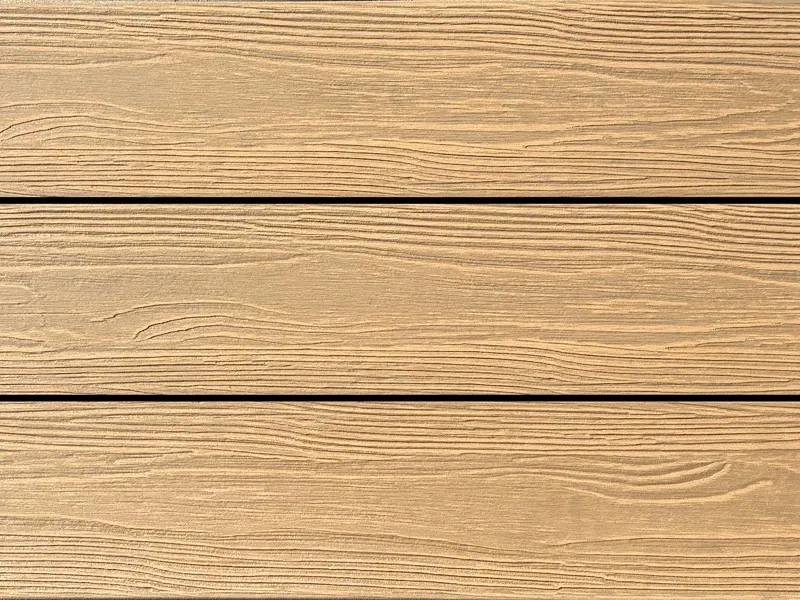 3100 × 140 × 22 mm
 Composite decking boards
Double-Sided Composite Decking Board — Teak-G
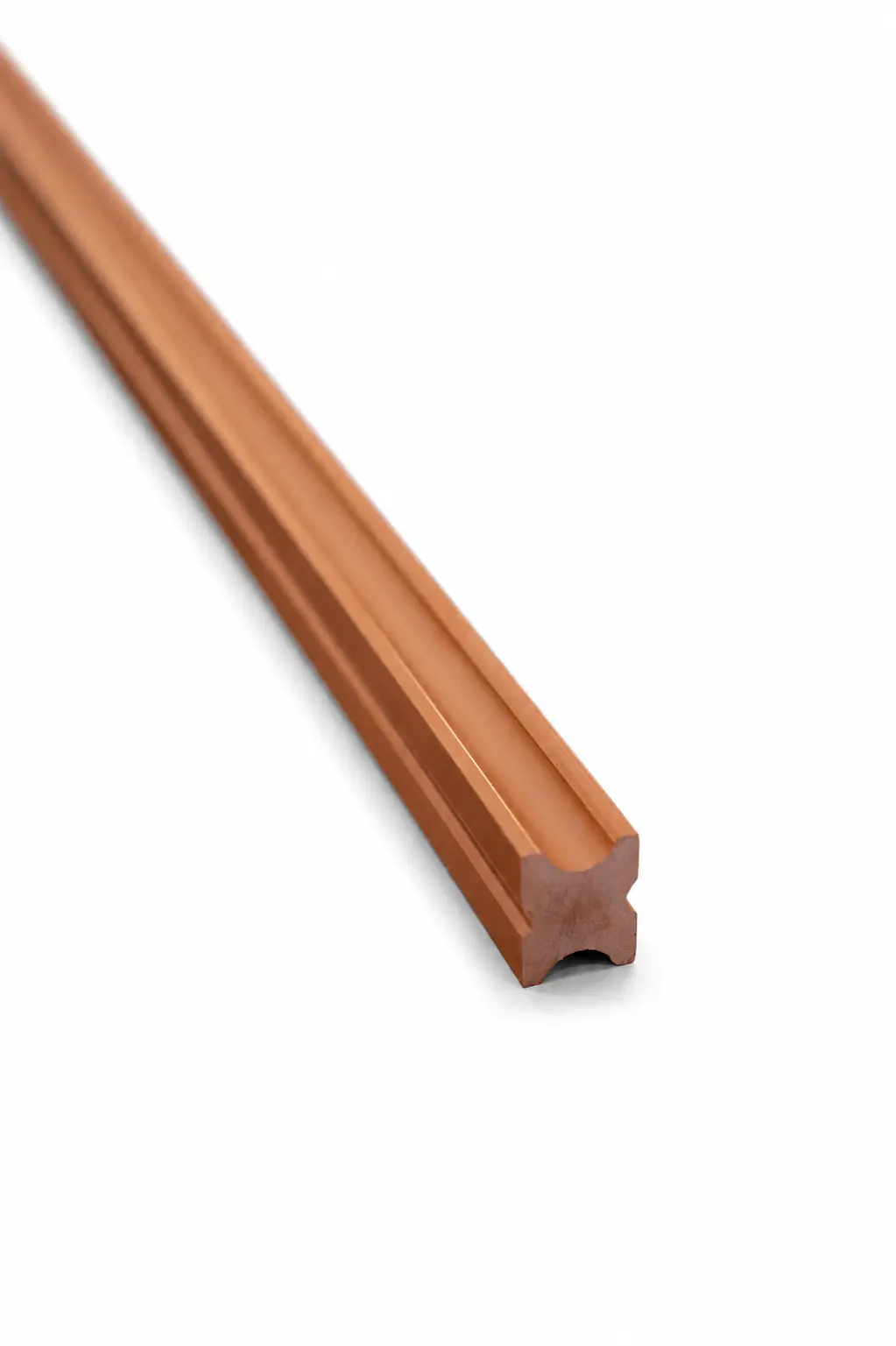 3100 × 40 × 30 mm
 Joists & accessories
WPC Decking Joist, Teak Brown — 3100 × 40 × 30 mm | DECNO Decking Substructure
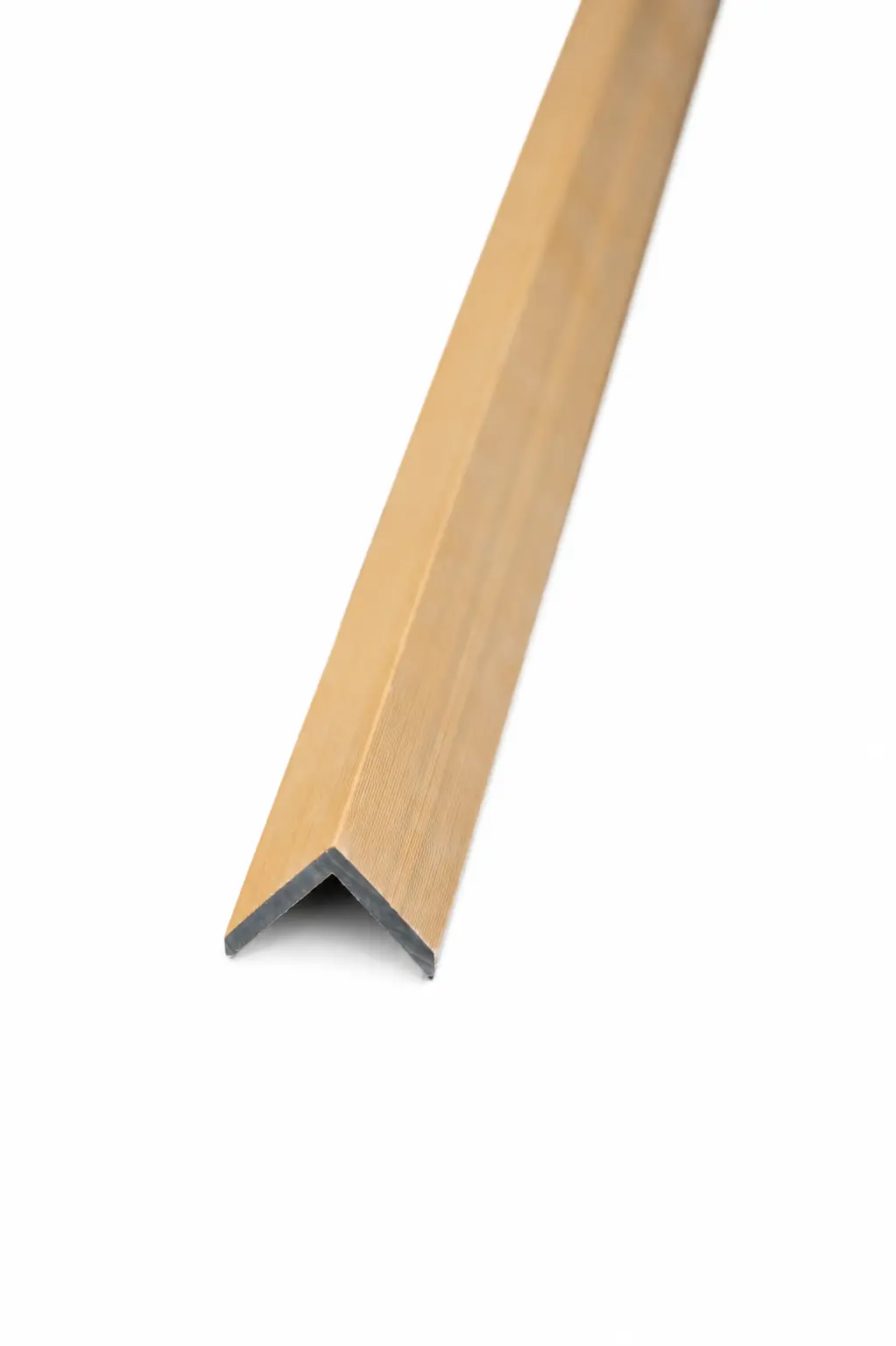 2900 × 50 × 50 mm
 Corner trims